
AI vis-A/GEO
Paid, Earned, Owned and....Answered
Building an Integrated AI - Are your communications, content, and advertising programs working toward the same customer decision? Let’s talk about bringing them together.
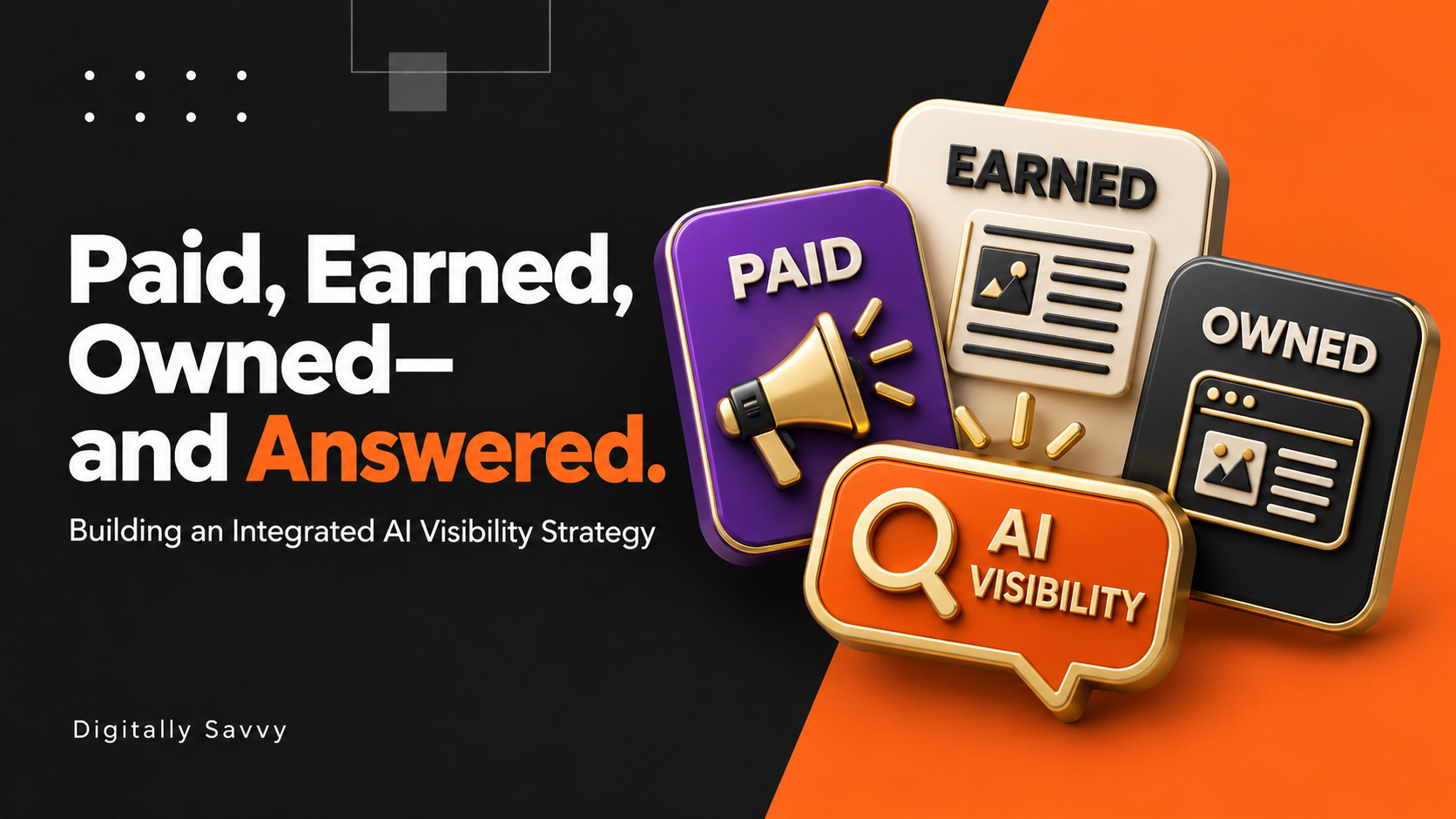
A prospective customer asks an AI tool which companies can help solve a business problem. Your company sells exactly what they need. Your advertising is running. Your website is current. Your PR team recently secured a strong media placement.
But does the answer include you? And if it does, does it explain why your company belongs in the conversation?
Those questions deserve a place in your marketing and communications strategy. They also expose a familiar problem: companies often manage paid media, public relations, content, and search as separate programs, even when those programs are trying to influence the same customer decision.
AI-assisted discovery gives those teams another reason to work together. The opportunity is to build a clear, credible presence across the places buyers—and the systems helping them research—may encounter your brand.
Start with the customer’s decision
Answer Engine Optimization (AEO) focuses on visibility in answer-based search experiences. Generative Engine Optimization (GEO) focuses on how brands and information appear in AI-generated responses. The terms overlap, and practices continue to evolve.
At Digitally Savvy, we approach AI visibility as a broader marketing and communications responsibility. It includes how a brand is discovered, described, evaluated, and supported by evidence, alongside relevant paid opportunities within AI-enabled discovery experiences.
The starting point is a customer question.
What problem is the buyer trying to solve? Which alternatives are they considering? What would they need to believe before contacting your company?
A buyer asking how to reduce fraud without frustrating legitimate customers needs a different answer from someone comparing identity verification providers. Both questions may matter to the same business, but they call for different content, supporting evidence, and next steps.
Understanding that distinction gives each channel a clearer job.
Owned content makes your expertise accessible
Your website should give prospective customers useful answers to the questions that shape a purchase. That means explaining what you do, who you serve, how your approach works, and what supports your claims.
Product pages, customer stories, research, executive perspectives, and practical guides can all contribute. Their value depends on their substance and accessibility. A page describing a company as an “innovative industry leader” offers less decision-making value than one explaining a specific capability, its limitations, and a documented customer outcome.
Technical foundations matter, too. Google’s guidance connects eligibility and visibility in its AI search features to established SEO practices, including accessible pages and helpful, reliable content. AEO and GEO should build on that foundation.
The editorial question is straightforward: would this page help a qualified buyer understand whether we can solve their problem?
Earned media adds independent perspective
As a media strategist, I look at earned coverage through the questions it helps a company answer. Does it explain the problem the business solves? Does it establish a leader’s expertise? Does it introduce evidence that makes the company’s position more credible?
A substantive interview, a customer-led story, or coverage of original research can give buyers another source to consult when evaluating a company. It also adds to the publicly available information that search and AI systems may encounter.
That makes the substance of a placement consequential. A passing mention and a detailed examination of a company’s expertise serve different purposes, even when both appear in respected publications.
No media placement guarantees inclusion in an AI answer. The strategic opportunity is to earn coverage that contributes something useful and accurate to the public understanding of your business.
Paid media creates additional opportunities to connect
Paid advertising belongs in this strategy because it can help reach relevant audiences and create a direct path from interest to action. Google already supports advertising within AI Overviews, making paid visibility part of the AI search landscape.
The distinction between advertising and organic visibility remains essential. Buying an ad does not buy an organic citation or an AI recommendation. Each requires its own strategy and measurement.
Within an integrated program, paid media can promote useful research, reach priority audiences, and connect buyers with a landing page that addresses their needs. Campaign insights can also help teams identify messages and questions worth investigating further.
The promise in the ad, the evidence on the website, and the story told through communications should support the same customer understanding.
What integration looks like in practice
Consider a hypothetical identity verification company trying to reach financial institutions. Its priority customer question is: “How can we reduce onboarding fraud without increasing customer abandonment?”
The company could build a program around that decision:
Owned: Publish a practical guide explaining the tradeoffs, supported by a customer example with clearly defined results.
Earned: Develop an executive perspective on the issue and pursue relevant coverage using original findings and a customer willing to discuss the experience.
Paid: Run campaigns around the buyer’s problem, directing prospects to content that answers the question and offers a relevant next step.
Search and AI visibility: Make the material accessible, maintain consistent factual descriptions, and examine whether relevant search results and AI answers accurately reflect the company’s capabilities.
The teams share a brief: audience, customer question, central message, supporting evidence, and desired action. Each team contributes its expertise, and each channel provides information that can improve the broader program.
That coordination also needs an owner. Someone must ensure that research reaches the PR team, coverage informs website content, campaign findings reach the editorial team, and outdated claims get corrected.
Measure visibility and business value
An integrated strategy needs measures that reflect both how the brand appears and what happens afterward.
Start with a defined set of commercially relevant questions. Review whether the company appears, how accurately it is described, which sources are cited, and how the answers vary across platforms and over time. Treat these observations as samples, because AI responses can change with context, timing, and the way a question is asked.
Then connect those findings with qualified website visits, content engagement, inquiries, sales feedback, and pipeline contribution where the evidence supports it. Keep paid performance identifiable so advertising results remain distinct from organic visibility.
Attribution will have limits. A customer may read coverage, encounter an AI answer, see an ad, and later arrive directly at your website. Reporting should acknowledge those gaps while helping the team make better decisions about content, investment, and execution.
Give every channel a shared purpose
AI visibility creates a useful test for integrated marketing and communications: can a prospective customer find a coherent, credible explanation of your value across the places they research?
Answering that question takes clear positioning, substantive evidence, coordinated distribution, and ongoing measurement. It also takes teams willing to work toward a shared customer decision.
At Digitally Savvy, we bring digital marketing and integrated communications together to help brands build that presence, from the stories they earn and the content they publish to the advertising that connects them with prospective customers.